

Leaves & needles
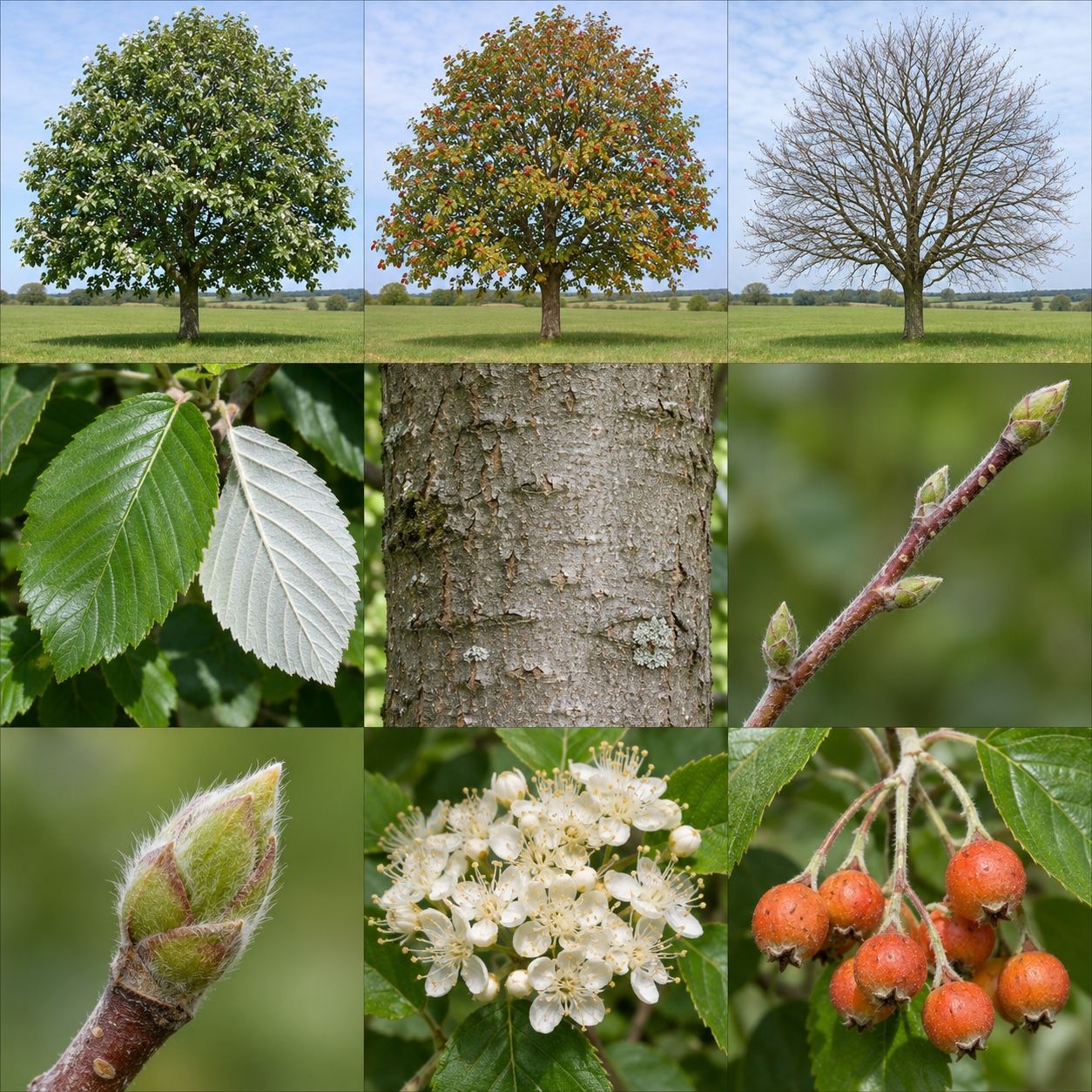
Oval, toothed and strongly veined, with a dense white felt on the underside.
Sorbus aria
A compact native tree of southern Britain, widely planted for its pale-backed leaves and orange-red berries.
THROUGH THE YEAR
A domed crown flashes silver-white as leaves turn in the breeze.
Foliage becomes gold or russet, with orange-red fruits.
A compact branching outline and pointed greenish buds.
Typical open-grown form. Leaf fall varies with weather and location; young or clipped trees may retain dead leaves. Pruned, sheltered and young trees can look different.
LOOK A LITTLE CLOSER
Oval, toothed and strongly veined, with a dense white felt on the underside.
Smooth grey bark, becoming more textured on older trunks.
Young shoots can be hairy, becoming smooth; exposed shoots may look brick-red.
Pointed greenish buds with pale hairs mainly along the scale edges.
Creamy-white, five-petalled flowers form broad clusters.
Orange-red berry-like fruits develop in clusters and remain into autumn.
Typical flowering: May, Jun. Weather and location change timing.
Images show typical features and are not to scale. Confirm several features using the reference sources below.
CARE WITH PURPOSE
Tolerates exposed, well-drained sites and chalk. Water while young and avoid persistent waterlogging.
Keep cuts small and selective; heavy crown reduction is poorly tolerated and disrupts its compact form.
June–August after leaf expansion
Highlighted months are an indicative window for the work described, not a reason to prune every year. An unshaded month is not an absolute ban.
Timing must suit the tree's health, weather, wildlife and legal protection. Avoid severe frost, drought and vulnerable new leaf growth. Mature trees, major branches and suspected defects need professional assessment.
The whitebeam group includes many local species and planted hybrids; this profile covers common whitebeam.
Guide researched November 2026. Identification remains provisional until several features agree. UK native means native in some part of the UK, not necessarily your area.
Before work in England, check tree preservation orders, conservation-area restrictions and wildlife protection. Official tree protection guidance ↗