

Leaves & needles
Oval, finely toothed, often opposite or nearly opposite; side veins curve strongly towards the tip.
Rhamnus cathartica
A native thorny shrub or small tree, often on lime-rich ground, with black berries and curved leaf veins.
THROUGH THE YEAR
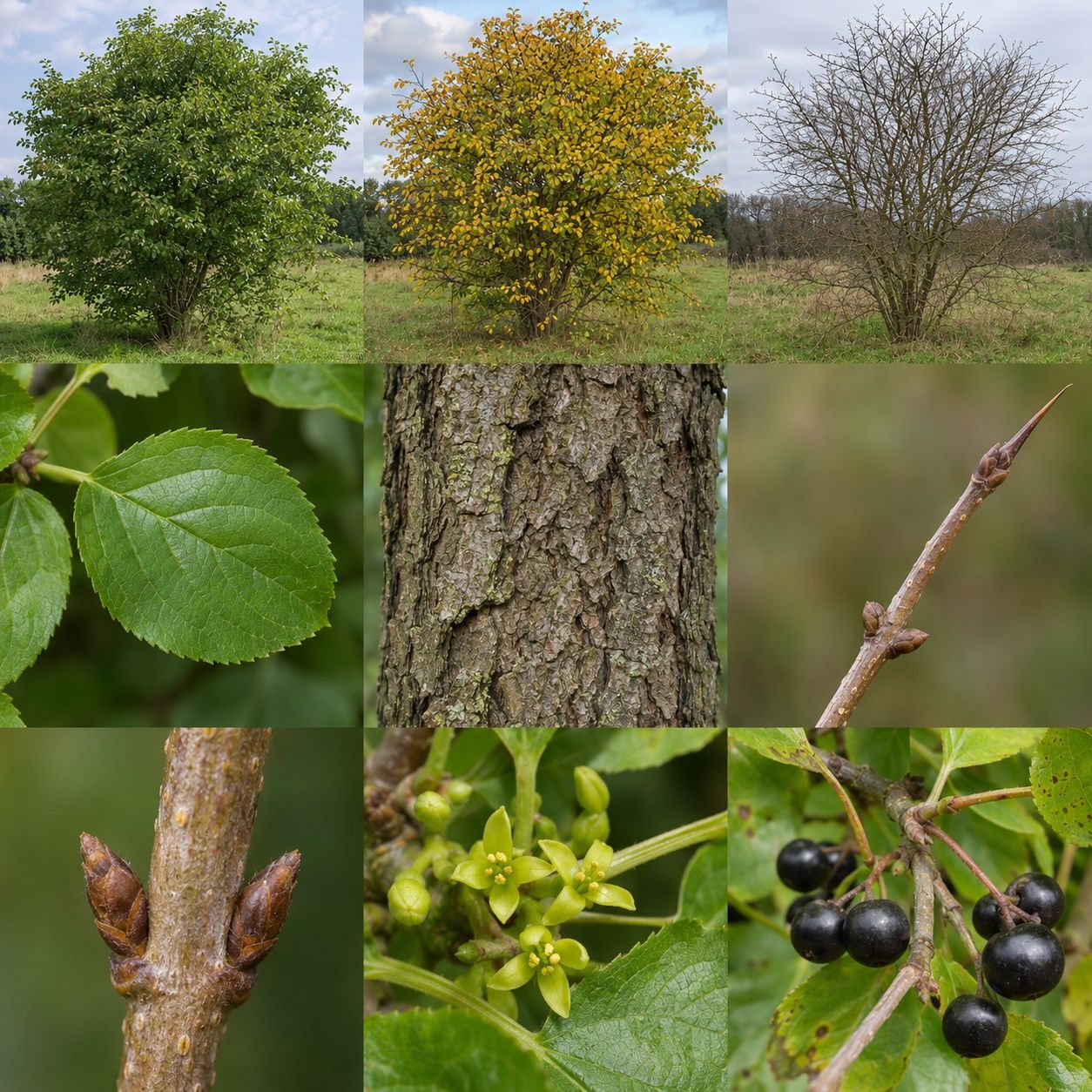
A dense branching shrub with glossy, curved-veined leaves.
Leaves turn yellow; black fruits remain on female plants.
Thorn-tipped shoots and closely appressed buds.
Typical open-grown form. Leaf fall varies with weather and location; young or clipped trees may retain dead leaves. Pruned, sheltered and young trees can look different.
LOOK A LITTLE CLOSER
Oval, finely toothed, often opposite or nearly opposite; side veins curve strongly towards the tip.
Grey-brown and increasingly rough; inner bark is orange, but do not strip it to check.
Slender brown shoots, often ending in a sharp thorn.
Narrow brown, scaled buds lie close to the twig, often in near-opposite pairs.
Tiny four-petalled yellow-green flowers appear in leaf axils, usually on separate male and female plants.
Female plants carry black berry-like fruits, typically containing several stones; do not eat them.
Typical flowering: May, Jun. Weather and location change timing.
Images show typical features and are not to scale. Confirm several features using the reference sources below.
CARE WITH PURPOSE
Suited to well-drained soils, including chalk, in sun or partial shade. Allow its natural shrubby shape where possible.
Thin selected stems rather than repeatedly shearing. Keep intervention modest to preserve berries and shelter.
November–February for light shaping
Highlighted months are an indicative window for the work described, not a reason to prune every year. An unshaded month is not an absolute ban.
Timing must suit the tree's health, weather, wildlife and legal protection. Avoid severe frost, drought and vulnerable new leaf growth. Mature trees, major branches and suspected defects need professional assessment.
Berries have a strong laxative effect and must not be eaten.
Guide researched November 2026. Identification remains provisional until several features agree. UK native means native in some part of the UK, not necessarily your area.
Before work in England, check tree preservation orders, conservation-area restrictions and wildlife protection. Official tree protection guidance ↗