

Leaves & needles
Rough, rounded-oval leaves with toothed edges, a short stalk and an unmistakably uneven base.
Ulmus procera
Now often encountered as hedgerow suckers. Its origin and classification within the field-elm complex are treated differently by sources.
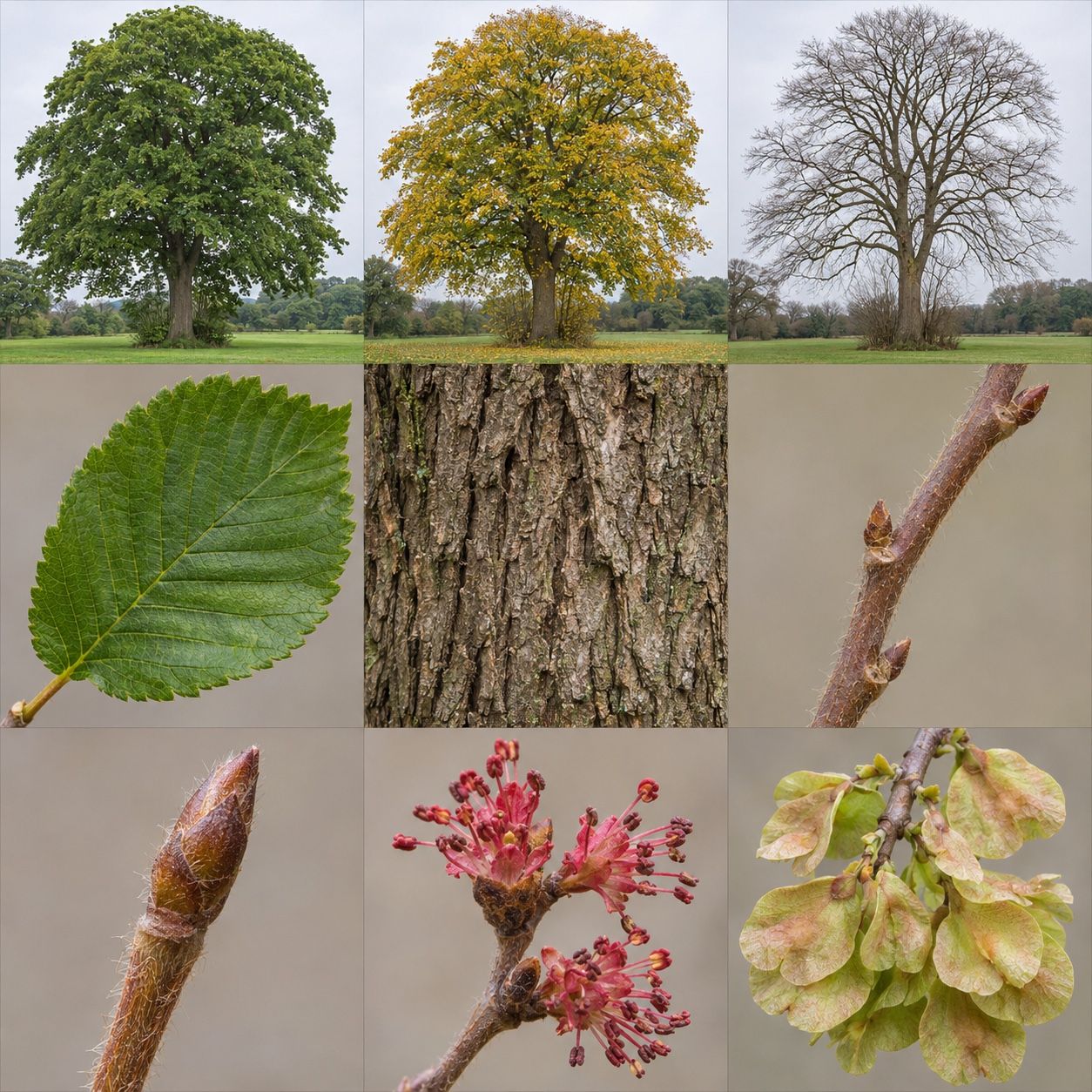
THROUGH THE YEAR
A tall domed crown if mature; many survivors are low, leafy sucker thickets.
Leaves turn yellow before falling.
Fine twigging, hairy buds and vigorous basal shoots.
Typical open-grown form. Leaf fall varies with weather and location; young or clipped trees may retain dead leaves. Pruned, sheltered and young trees can look different.
LOOK A LITTLE CLOSER
Rough, rounded-oval leaves with toothed edges, a short stalk and an unmistakably uneven base.
Grey-brown, rough and deeply fissured on older stems.
Slender shoots carry fine reddish hairs; root suckers are common.
Small oval, pointed brown buds with sparse reddish hairs; flower buds are rounder.
Small dark pink-red flower clusters open before the leaves, usually in February–March.
Flat, papery winged fruits may develop in spring, but viable seed production is often poor.
Images show typical features and are not to scale. Confirm several features using the reference sources below.
CARE WITH PURPOSE
Protect surviving elms and their roots from damage. Monitor new wilting or branch dieback promptly; disease management benefits from local professional advice.
Keep planned cuts small and preserve healthy structure. Suspected Dutch elm disease needs prompt assessment, rather than waiting for a routine pruning window.
Usually November–February for planned work; urgent disease work follows diagnosis
Highlighted months are an indicative window for the work described, not a reason to prune every year. An unshaded month is not an absolute ban.
Timing must suit the tree's health, weather, wildlife and legal protection. Avoid severe frost, drought and vulnerable new leaf growth. Mature trees, major branches and suspected defects need professional assessment.
New summer wilting and browning may indicate Dutch elm disease; arrange inspection promptly.
Guide researched November 2026. Identification remains provisional until several features agree. UK native means native in some part of the UK, not necessarily your area.
Before work in England, check tree preservation orders, conservation-area restrictions and wildlife protection. Official tree protection guidance ↗