

Leaves & needles
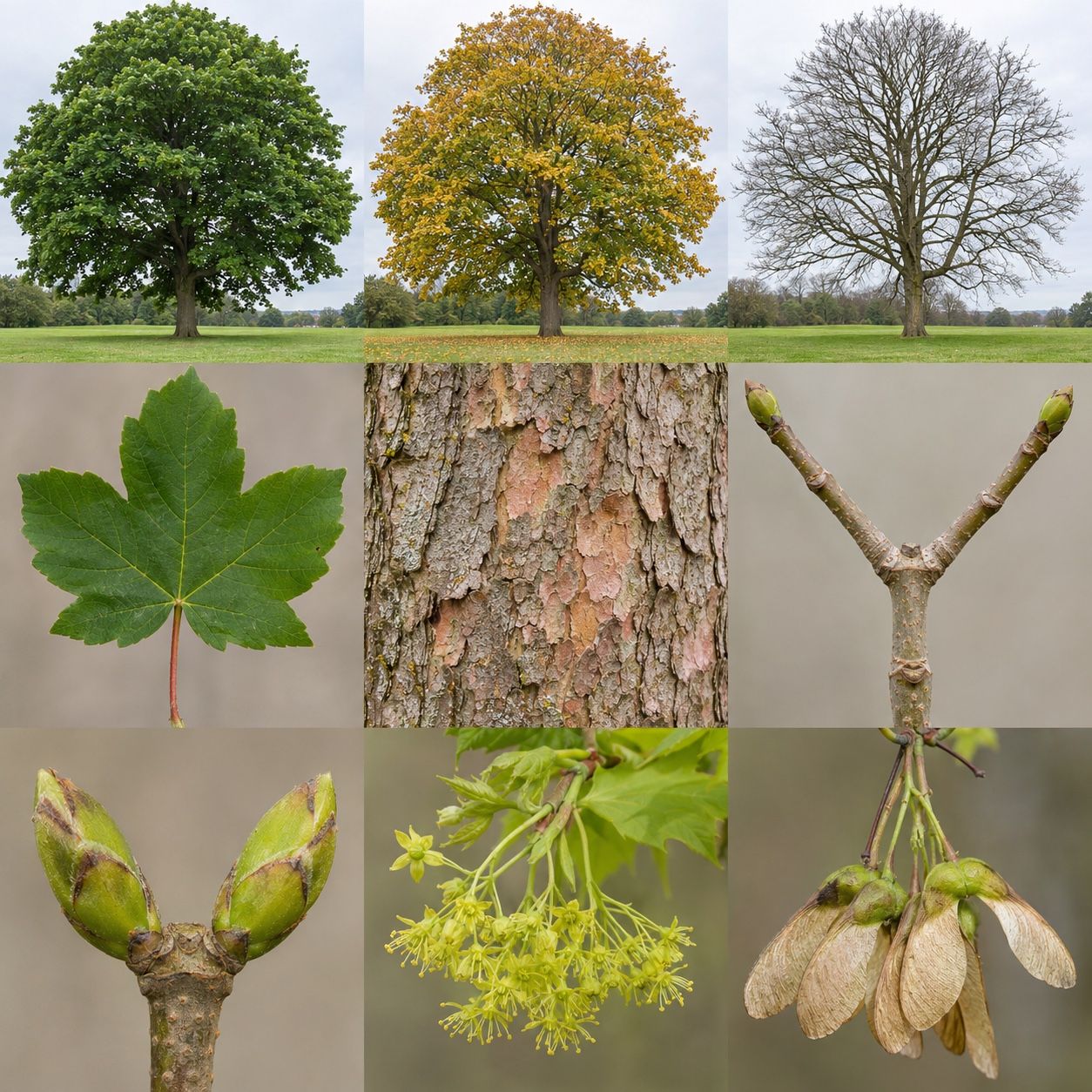
Five broad, toothed lobes; often dark green above with reddish leaf stalks.
Acer pseudoplatanus
A vigorous, broad-crowned maple, familiar in gardens, streets and self-seeded woodland.
THROUGH THE YEAR
A dense, rounded canopy on spreading branches.
Usually yellow or brown; paired winged seeds ripen.
Stout forks and green paired buds stand out.
Typical open-grown form. Leaf fall varies with weather and location; young or clipped trees may retain dead leaves. Pruned, sheltered and young trees can look different.
LOOK A LITTLE CLOSER
Five broad, toothed lobes; often dark green above with reddish leaf stalks.
Grey bark becomes flaky, exposing pinkish or orange patches.
Stout, opposite branching; greenish young shoots become grey-brown.
Plump green buds in opposite pairs, with dark-edged scales.
Drooping yellow-green flower clusters appear with or shortly after the leaves in spring.
Paired winged seeds hang in clusters; the wings form a fairly narrow angle.
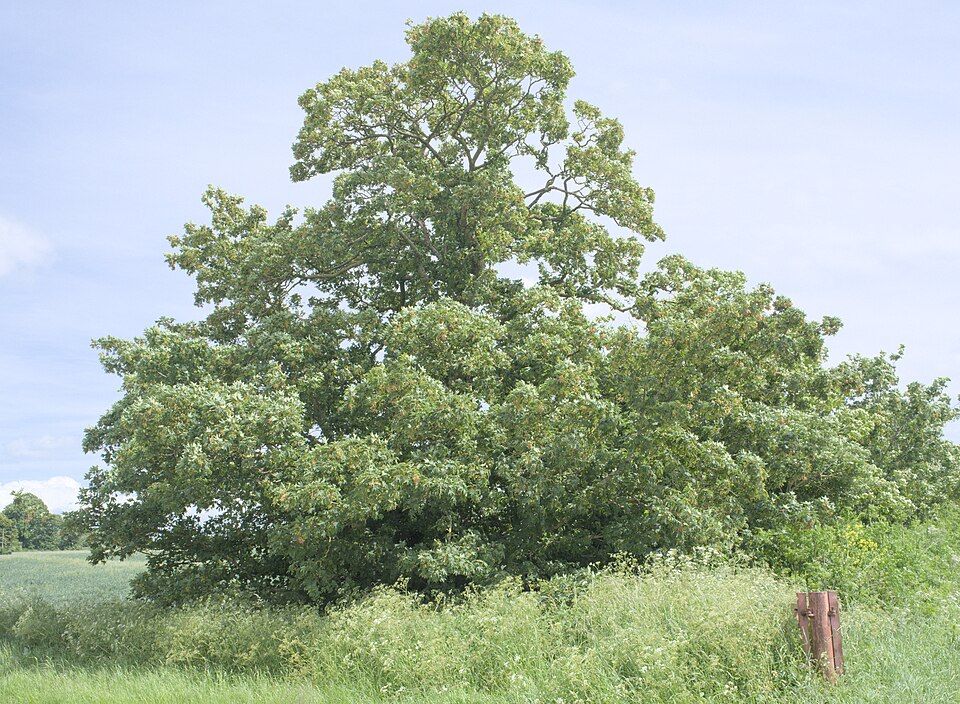
Dunsby, Lincolnshire, England, United Kingdom
A mature sycamore in leaf at Dunsby.
Acer pseudoplatanus — Acer pseudoplatanus by Bob Harvey / Geograph · CC BY-SA 2.0 · Original photograph ↗Images show typical features and are not to scale. Confirm several features using the reference sources below.
CARE WITH PURPOSE
Allow room for its eventual crown. Tolerates exposed conditions and varied soils; keep young trees watered during drought. Remove unwanted seedlings early.
Retain a balanced framework. Selectively remove rubbing or poorly placed small branches. Avoid routine topping or drastic size reduction.
November–January, while dormant; late-summer work may also be suitable
Highlighted months are an indicative window for the work described, not a reason to prune every year. An unshaded month is not an absolute ban.
Timing must suit the tree's health, weather, wildlife and legal protection. Avoid severe frost, drought and vulnerable new leaf growth. Mature trees, major branches and suspected defects need professional assessment.
Black tar spots on leaves usually look worse than their effect on tree health.
Guide researched November 2026. Identification remains provisional until several features agree. UK native means native in some part of the UK, not necessarily your area.
Before work in England, check tree preservation orders, conservation-area restrictions and wildlife protection. Official tree protection guidance ↗