

Leaves & needles
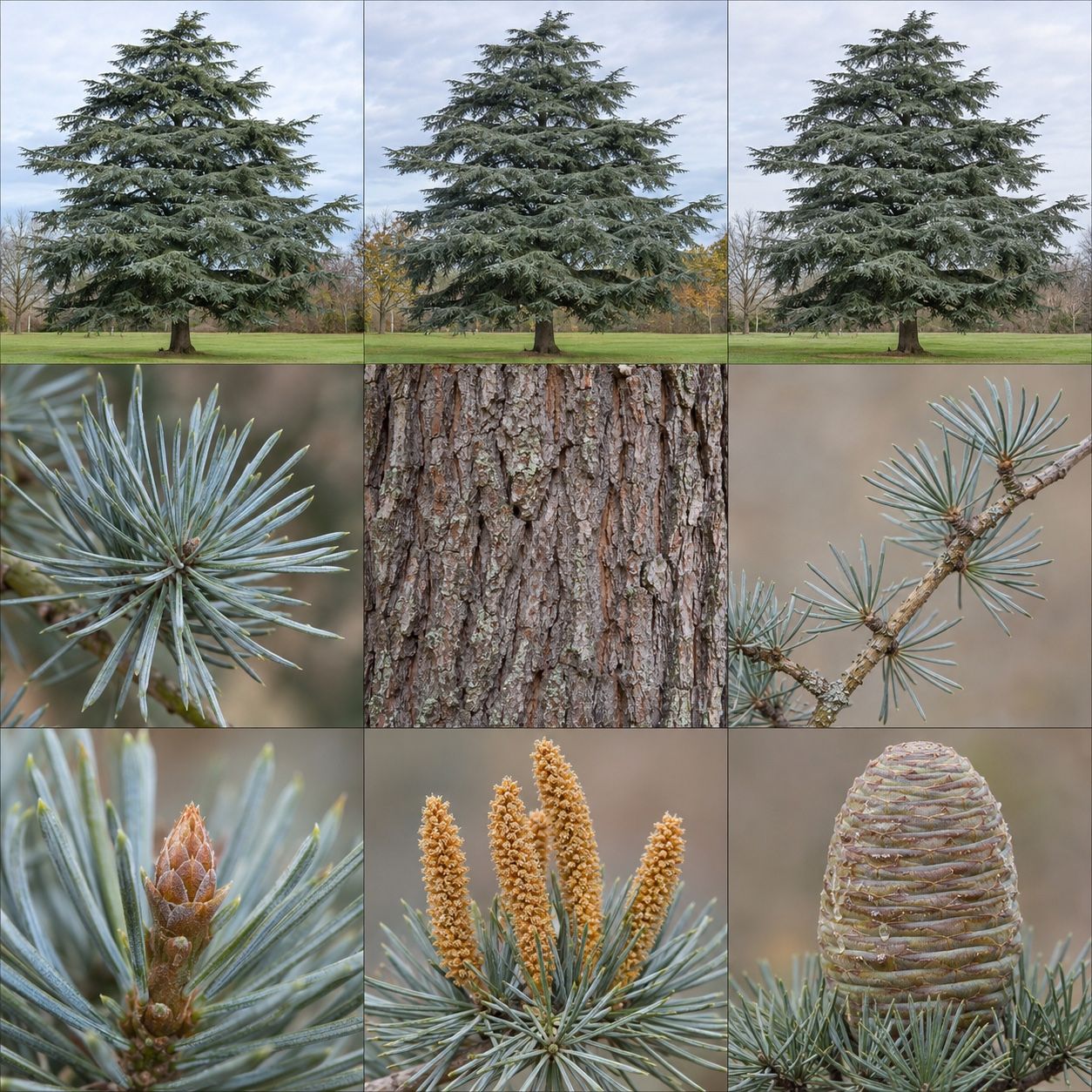
Short stiff needles, often blue-grey, gather in dense rosettes; green forms also exist.
Cedrus atlantica
Often grown in its blue form, this cedar broadens into an imposing specimen.
THROUGH THE YEAR
Conical when young, becoming broader and irregularly tiered.
Retains blue-grey or green foliage; barrel-shaped cones stand upright.
Evergreen layers remain; branch ends often sweep upwards.
Typical open-grown form. This tree keeps foliage in winter, shedding older leaves or needles gradually. Pruned, sheltered and young trees can look different.
LOOK A LITTLE CLOSER
Short stiff needles, often blue-grey, gather in dense rosettes; green forms also exist.
Grey-brown bark develops ridges and fissures.
Young shoot tips commonly angle upwards; needle-bearing spur shoots are conspicuous.
Small buds on shoot tips and amongst needle clusters; needles obscure much of the bud.
No true flowers: upright male cones release pollen in early autumn.
Upright barrel-shaped cones disintegrate on the tree when mature.
Images show typical features and are not to scale. Confirm several features using the reference sources below.
CARE WITH PURPOSE
Give full sun, free drainage and plenty of space. Water while establishing; avoid compacting soil beneath older trees.
Retain natural tiers and the leader. Seek advice before altering large branches.
April–August if necessary
Highlighted months are an indicative window for the work described, not a reason to prune every year. An unshaded month is not an absolute ban.
Timing must suit the tree's health, weather, wildlife and legal protection. Avoid severe frost, drought and vulnerable new leaf growth. Mature trees, major branches and suspected defects need professional assessment.
Blue foliage alone does not reliably separate this from other cedars.
Guide researched November 2026. Identification remains provisional until several features agree. UK native means native in some part of the UK, not necessarily your area.
Before work in England, check tree preservation orders, conservation-area restrictions and wildlife protection. Official tree protection guidance ↗